Schedow: The Simple Tool That Could Change How You Plan Your Day
Planning your day should not feel like a second job. Yet for many people, it does. You wake up with a rough idea of what needs to get done, then the day quickly fills up with meetings, messages, reminders, deadlines, small errands, and unfinished tasks from yesterday.
That is exactly why Schedow is getting attention. It speaks to a simple problem most people know too well: we have more things to manage than our memory can comfortably hold.
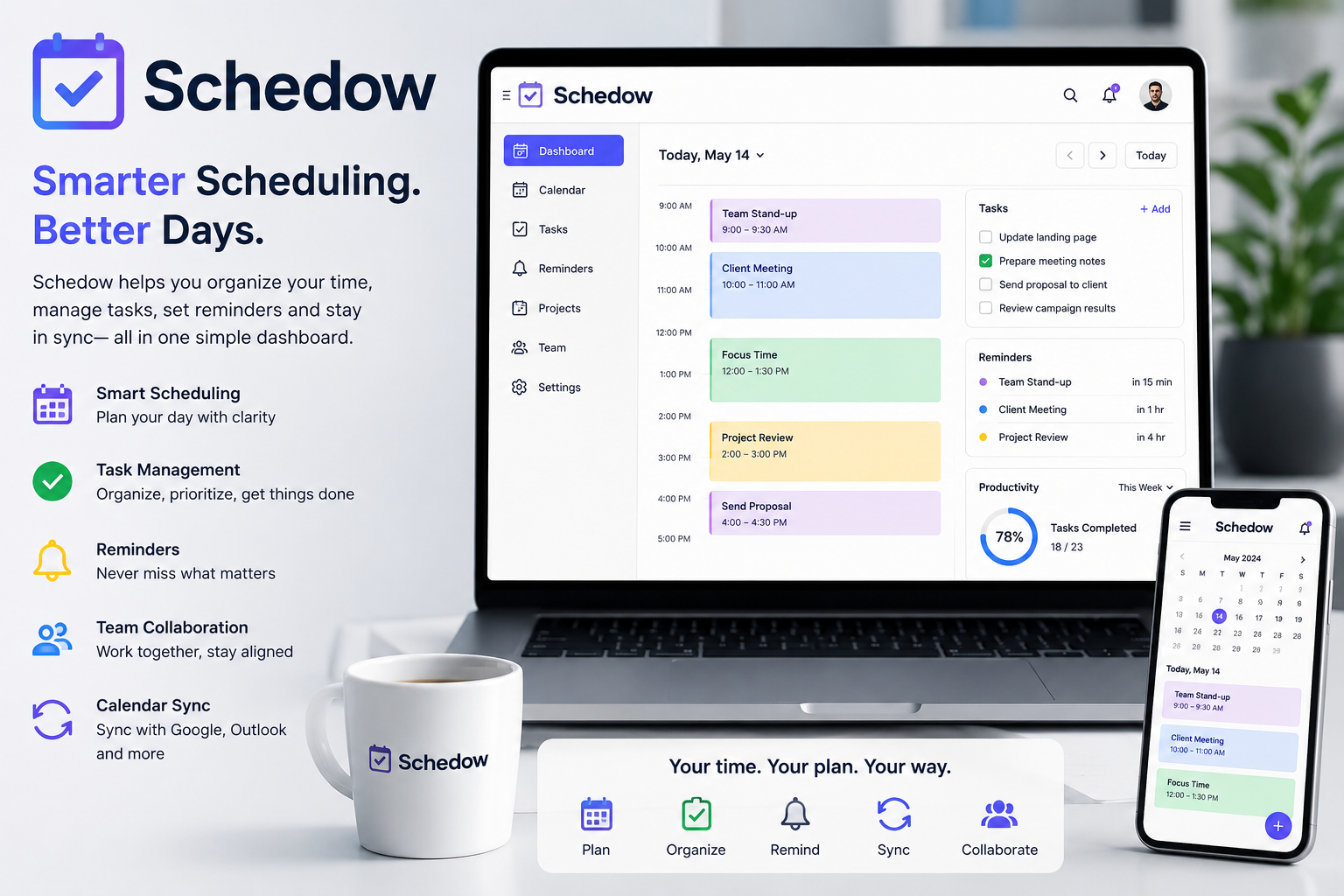
At its core, Schedow is connected with smart scheduling, daily planning, time management, and better control over your routine. Instead of leaving your tasks scattered across notes, calendars, messages, and mental reminders, it gives you a more organized way to see what matters, when it matters, and how your time is being used.
The real value of Schedow is not just that it helps you create a schedule. A regular calendar app can already do that. The bigger idea is that Schedow can help make your day feel clearer, lighter, and easier to manage.
What Is Schedow?
Schedow can be understood as a modern scheduling tool built around the way people actually work today. It is often described as a productivity tool, a time management app, and a smarter way to handle tasks, meetings, reminders, and daily routines.
Think of it as a planning space where your to-do list, calendar, appointments, and priorities can come together. Instead of checking one app for meetings, another for tasks, another for reminders, and another for team updates, Schedow is built around the idea of keeping your planning flow more connected.
That is what makes it different from a basic online calendar. A normal calendar mostly shows what you have already added. Schedow is more about helping you organize your day with better structure. It fits naturally with terms people often search for, such as smart scheduling app, task management software, calendar sync, appointment scheduling, meeting scheduler, and workflow management.
In simple words, Schedow helps you stop guessing what to do next.
Why Planning Your Day Feels So Hard Now
Most people are not lazy or bad at planning. They are overloaded.
A normal workday can include emails, calls, video meetings, client updates, school work, personal errands, team messages, and random tasks that appear out of nowhere. The problem is not always the number of tasks. The real problem is that everything competes for attention at the same time.
That is where daily planning becomes difficult. You may have a to-do list, but it does not always tell you what should happen first. You may have a calendar app, but it may only show meetings, not the actual work you need to complete between those meetings. You may set reminders, but too many alerts can become noise.
This is the gap Schedow tries to fill. It connects the idea of a daily planner, task organizer, and time blocking tool into one smoother planning experience.
When your tasks are organized properly, you do not waste half the day deciding where to start. You can see your work, your available time, and your priorities more clearly.
How Schedow Helps You Plan Smarter
The biggest benefit of Schedow is that it supports smarter planning without making the process feel complicated.
A good schedule is not just a list of things packed into every empty space. A good schedule gives your day shape. It shows what needs attention, what can wait, and where you need space to focus.
With Schedow, the idea is to make schedule optimization more natural. You can organize meetings, tasks, reminders, and deadlines in a way that helps you avoid overbooking yourself. Instead of treating every task as equally urgent, you can use priority management to decide what deserves the best part of your day.
For example, a busy professional might use Schedow to block time for deep work before meetings begin. A freelancer might use it for client scheduling, project deadlines, and follow-ups. A student might use it as a study planner for classes, assignments, and exam preparation.
This is why people searching for tools like productivity app, calendar management, deadline tracking, work schedule planner, and automated reminders may find Schedow relevant.
It is not about filling your day with more tasks. It is about making the day easier to handle.
Key Features That Make Schedow Useful
Smart Scheduling
Smart scheduling is one of the main ideas connected with Schedow. Instead of manually arranging every task and meeting, the goal is to make scheduling feel more intelligent and less tiring.
A smart schedule helps you avoid conflicts, protect important work time, and plan around what matters most. If your day is already full, Schedow can help you think more carefully about where new tasks should fit.
This matters because poor scheduling often creates stress. You agree to one meeting, forget about another task, push important work to the evening, and end the day feeling behind. With better schedule management, you can create a day that feels realistic instead of chaotic.
Calendar Sync
One of the most useful parts of any modern scheduling app is calendar sync. People already use tools like Google Calendar, Outlook, or other digital calendars, so a planning tool becomes more helpful when it works with the systems they already have.
With Schedow, calendar integration can help keep meetings, tasks, reminders, and appointments updated in one place. That means fewer missed commitments, fewer double bookings, and less jumping between apps.
A connected schedule gives you a better view of your real day. You can see when you are busy, when you have space, and when you should not take on more.
For anyone searching for Google Calendar sync, Outlook calendar integration, shared calendar, or calendar management tool, this is one of the most important benefits to understand.
Task Management
A schedule is only useful if it connects to the work you actually need to do. That is why task management is such a big part of Schedow.
Instead of keeping tasks in random notes or relying on memory, you can organize them with deadlines, priorities, and categories. This makes your work feel more visible and less overwhelming.
Good task management software helps you break large goals into smaller actions. It also helps you track what is still pending, what is urgent, and what can be moved to another day.
This is especially helpful for people managing several responsibilities at once. A freelancer may need to track client work. A small business owner may need to manage appointments and follow-ups. A student may need to manage assignments and study time. A team leader may need to keep project tasks moving.
In each case, Schedow works best when it helps turn a messy list into a clear plan.
Automated Reminders
Everyone forgets things. That is not a personal failure. It is just what happens when your brain is carrying too much.
Automated reminders make planning easier because they reduce the pressure to remember every detail on your own. A reminder for a meeting, deadline, follow-up, or personal task can save you from last-minute panic.
The key is balance. Helpful reminders should support your day, not interrupt it every few minutes. With Schedow, reminders are most useful when they are tied to real priorities.
For example, you might set reminders for a client call, a report deadline, a payment follow-up, or a study session. You can also use reminders to build simple habits, such as reviewing your schedule every morning.
This connects naturally with search terms like reminder app, deadline reminders, task reminders, appointment reminders, and notification management.
Time Blocking and Focus Mode
One of the biggest problems with modern work is that open time disappears quickly. If you do not protect your focus time, someone else’s meeting or message will usually take it.
That is where time blocking becomes useful.
With time blocking, you give important tasks a specific place in your day. Instead of saying, “I will work on this later,” you decide when it will happen. This makes deep work more likely because the task has a real space on your schedule.
Schedow also connects well with the idea of focus mode. A focus-friendly schedule helps reduce distractions, silence unnecessary noise, and keep your attention on one task at a time.
This is especially useful for people doing writing, design, studying, coding, planning, client work, or any task that needs concentration. A calendar full of meetings may make you look busy, but protected focus time is often where real progress happens.
Team Collaboration
Planning becomes more complicated when other people are involved. A single person can adjust their own day fairly easily, but a team has to manage availability, responsibilities, deadlines, and communication.
That is why team collaboration is another important part of the Schedow conversation.
For teams, a shared calendar can help everyone understand who is available, what is due, and where work is moving. It can reduce the endless back-and-forth of “What time works for you?” and “Who is handling this?”
A good team scheduling system also helps avoid confusion. When tasks, meetings, and deadlines are visible, people are less likely to miss updates or duplicate work.
This is useful for remote teams, small businesses, project managers, agencies, and anyone working across different schedules.
Productivity Insights
Sometimes the problem is not that you are doing too little. It is that you do not know where your time is going.
That is where productivity insights can help. If Schedow shows patterns in your schedule, task completion, meeting load, or focus time, you can make better decisions about your routine.
For example, you might realize that your mornings are better for deep work, your afternoons are full of meetings, or your schedule gets overloaded every Thursday. That kind of visibility can help you plan smarter next week.
This connects with terms like productivity tracking, time tracking, workload management, productivity analytics, and weekly planning.
The goal is not to judge every minute of your day. The goal is to understand your habits well enough to improve them.
Who Can Use Schedow?
Busy Professionals
Busy professionals often deal with meetings, calls, emails, deadlines, and follow-ups every single day. A tool like Schedow can help bring those moving parts into a clearer system.
For professionals, the biggest benefit may be better meeting scheduling, stronger deadline tracking, and less mental clutter. Instead of starting the day with a vague list of things to handle, they can build a plan around priorities.
A strong work schedule planner helps professionals avoid the trap of being busy all day without making real progress.
Freelancers
Freelancers need structure, even if their work looks flexible from the outside. They have to manage client calls, project timelines, revisions, invoices, admin tasks, and personal work habits.
Schedow can support a better freelance workflow by helping freelancers organize client scheduling, project deadlines, and follow-ups in one place.
This is especially helpful when working with multiple clients. Without a clear system, small tasks can easily fall through the cracks. With better project management and appointment scheduling, freelancers can look more professional and feel more in control.
Students
Students often have more to manage than people realize. Classes, assignments, exams, group projects, part-time work, and personal responsibilities can pile up quickly.
As a study planner, Schedow can help students plan study sessions, track assignment deadlines, and avoid last-minute cramming. It can also help create a more balanced daily routine by making time for breaks, revision, and focused learning.
For students searching for a time management app, assignment tracker, or student planner, Schedow fits naturally into that need.
Remote Teams
Remote work gives people flexibility, but it also creates scheduling challenges. Team members may work in different locations, time zones, or routines. Without clear planning, meetings overlap, updates get missed, and work becomes harder to coordinate.
Schedow can help remote teams with team scheduling, shared calendars, workflow automation, and better visibility across tasks.
A remote team does not need more meetings. It needs better coordination. A clear schedule helps people know when to collaborate and when to focus.
Small Businesses
Small businesses often need simple systems that save time without creating extra work. Owners and teams may need to handle appointments, staff schedules, customer follow-ups, project timelines, and daily operations.
Schedow can support business scheduling, appointment booking, team coordination, and workflow management. For service-based businesses, it can help reduce missed appointments and make customer communication feel smoother.
The benefit is not only organization. It can also make the business look more reliable and professional.
Schedow vs a Regular Calendar App
A regular calendar app is useful, but it has limits.
A calendar can show meetings, appointments, and events. But it may not help you decide which task should come first, how much time you need for deep work, or whether your day is already overloaded.
That is where Schedow has a stronger planning angle. It connects scheduling with task management, automated reminders, time blocking, calendar sync, and productivity tracking.
A calendar tells you what is happening.
Schedow helps you think about how your day should work.
That difference matters. Many people do not need another place to store dates. They need a better way to organize their time, protect their attention, and keep important tasks visible.
How Schedow Can Change the Way You Plan Your Day
The biggest change Schedow can bring is mental clarity.
When your schedule is scattered, your mind keeps checking for missing pieces. Did I reply to that client? Do I have a meeting today? When is the assignment due? What task was I supposed to finish before lunch?
That mental checking is exhausting.
With Schedow, the goal is to reduce that load. You can start the day with a clearer view of your tasks, meetings, reminders, and available time. You can see what matters most and what can wait.
This makes it easier to create a realistic plan. You can protect focus time, leave space for unexpected work, and avoid filling every hour just because it is empty.
A good planning tool should not make you feel trapped by your schedule. It should help your day feel more manageable.
That is why Schedow connects so well with work-life balance. Better planning gives you a better chance of finishing work on time, avoiding unnecessary stress, and keeping personal time from being swallowed by poor scheduling.
Practical Ways to Get More Out of Schedow
Start small. Do not try to organize your entire life in one sitting. That usually creates more pressure, not less.
Begin by adding the tasks that truly matter today. Then add your meetings, deadlines, and reminders. Once the basics are in place, use priority management to decide what needs your best energy.
Next, use time blocking for the work that needs focus. Even one protected hour can make a big difference. If you have a report to write, a project to review, or a study session to complete, give it a clear place in your schedule.
Use automated reminders for tasks you cannot afford to miss, but do not set alerts for everything. Too many reminders can train you to ignore them.
If calendar sync is available, connect your existing calendar so your meetings and tasks stay aligned. This helps prevent double bookings and gives you a more complete view of your day.
It also helps to review your schedule at the end of the week. A quick review can show what worked, what kept getting delayed, and where your schedule became too crowded.
The best way to use Schedow is to let it become part of your routine slowly. A simple system you actually use is better than a complicated setup you abandon after three days.
Common Mistakes to Avoid When Using Schedow
The first mistake is adding too much too soon. A planning tool should make your day clearer, not turn into a giant list of every possible thing you might do.
The second mistake is ignoring priorities. If every task looks equally important, your schedule will still feel stressful. Use priority management to separate urgent work from nice-to-do tasks.
Another mistake is overbooking your day. Empty space is not wasted space. You need room for breaks, delays, unexpected messages, and tasks that take longer than planned.
Some users may also rely too much on automation. Workflow automation can save time, but it should not replace mindful planning. You still need to review your schedule and decide whether your plan matches your real goals.
Finally, do not treat Schedow like a storage box. It is not just a place to dump tasks. It works best when you use it as a living plan that changes with your day.
Is Schedow Worth Using?
Schedow is worth considering if your current planning system feels scattered. If your tasks are in one place, meetings in another, reminders somewhere else, and important follow-ups stuck in your head, you probably need a cleaner system.
It may be especially useful if you care about smart scheduling, task management, calendar sync, appointment scheduling, time blocking, and better daily planning.
That said, no tool can magically fix a messy routine overnight. The value comes from how consistently you use it. Schedow can give you the structure, but you still need to set priorities, review your schedule, and make realistic choices about your time.
For people who want a simple way to plan better without making productivity feel complicated, Schedow can be a helpful step forward.
A Simple Way to Start Using Schedow Today
Open your schedule and choose the three tasks that matter most today. Not ten. Not twenty. Just three.
Add your meetings or appointments, then look at the open spaces between them. Choose one block of time for focused work and protect it. Add reminders only for the tasks that truly need them.
If you are using Schedow for work, add your most important deadlines and follow-ups. If you are using it for study, add your classes, assignments, and revision time. If you are using it for business, add appointments, client calls, and admin tasks.
The goal is not to build a perfect schedule. The goal is to build a schedule you can actually follow.
That is where Schedow can change how you plan your day. It gives your time more structure, your tasks more visibility, and your mind a little more breathing room.