
What Is Repmold? A Simple Guide for Beginners
If you have recently come across the word Repmold, you are probably wondering what it actually means. It sounds technical, but the idea behind it is easy to understand once you break it down.
In simple words, Repmold is often used to describe a modern way of creating, copying, testing, and improving molds with the help of digital tools. Instead of relying only on slow manual methods, this approach brings together mold making, mold replication, digital design, CAD software, 3D printing, rapid prototyping, and automated production methods.
That makes it useful for businesses that need accurate parts, faster product testing, and more flexible manufacturing. It is especially connected with industries where small design changes, clean details, and repeatable quality matter.
What Does Repmold Mean?
The word Repmold can be understood as a mix of two ideas: replication and molding.
“Rep” points toward replication, which means making a copy or repeat version of something. “Mold” refers to the shaped tool used to produce parts from plastic, resin, rubber, metal, or other materials. When these ideas come together, Repmold becomes a term linked with mold replication and smarter mold production.
In a manufacturing setting, Repmold is not just about making a mold. It is about making the process faster, more accurate, and easier to adjust. A company may use a digital file, create a prototype, test the shape, improve the design, and then use that mold to make consistent parts.
This is why people often connect Repmold technology with modern manufacturing, precision manufacturing, rapid tooling, and smart manufacturing.
Why Repmold Is Getting Attention
Manufacturers are under pressure to work faster without lowering quality. Customers want better products, businesses want lower costs, and product teams want the freedom to test new ideas without wasting months.
That is where Repmold becomes useful.
Traditional mold making can be slow and expensive, especially when a product is still being tested. If the design changes, the mold may need to be changed too. In some cases, teams have to start again, which adds cost and delays.
With a more digital process, engineers can adjust the design earlier. They can use CAD design, create a sample through 3D printing molds or CNC machining, test the result, and improve it before going into bigger production.
This makes Repmold helpful for companies that care about product development, low-volume manufacturing, and quick design changes.
How Repmold Works
The exact process can vary depending on the material, industry, and product. Still, most Repmold workflows follow a similar path.
Step 1: Creating the Digital Design
The process usually starts with a digital design. Engineers or product designers create a model using CAD software. This digital model shows the shape, size, surface details, and structure of the part or mold.
This step is important because the mold must be accurate from the beginning. If the digital model has mistakes, those mistakes can carry into the physical mold.
Many teams also use digital simulation to check how the mold might behave before anything is made. This can help spot weak points, flow issues, heat problems, or design flaws early.
Step 2: Making a Prototype Mold
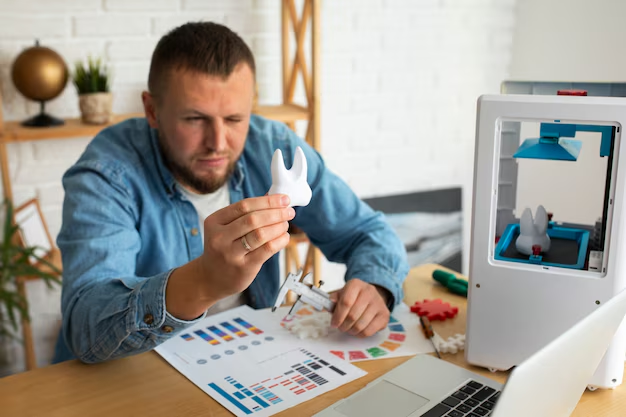
Once the design is ready, the next step is creating a prototype or test mold. This may involve 3D printing, CNC machining, resin casting, silicone molding, or other rapid prototyping methods.
The goal is not always to create the final production mold right away. The first version is often used for testing. Teams can check the size, shape, fit, finish, and strength before spending more money on a durable production tool.
This is one of the biggest reasons Repmold is useful. It gives companies a safer way to test ideas before moving into full production.
Step 3: Testing the Mold
After the prototype mold is made, it needs to be tested. A team may check whether the mold creates the right shape, whether the surface finish looks clean, and whether the material behaves properly.
In some cases, they also test heat resistance, pressure, curing time, and durability. These details matter because even a small issue can affect the final product.
For example, in injection molding, the mold must handle heat and pressure while keeping the final part accurate. In other molding methods, the team may focus more on curing time, flexibility, or the way the material fills the mold cavity.
Step 4: Improving the Design
If testing shows a problem, the design can be changed. This is where Repmold has a clear advantage over older workflows.
Instead of rebuilding everything from scratch, the team can go back to the CAD model, make adjustments, and create a better version. This helps reduce rework, save material, and shorten the time between idea and production.
This is also helpful for businesses that need custom manufacturing or products with frequent updates.
Step 5: Producing Consistent Parts
Once the mold works well, it can be used to produce parts with better consistency. Modern molding technology may include sensors, automated controls, quality control checks, and production tracking.
These tools help make sure each part stays close to the original design. For industries like medical devices, automotive parts, electronics, and aerospace, consistency is not optional. A tiny difference can affect safety, performance, or customer trust.
Repmold vs Traditional Mold Making
Traditional mold making is still important and widely used. Strong steel molds, aluminum molds, and other durable tools are often the best choice for large-scale production.
But traditional methods can be less flexible when a product is still changing. If a business commits to a permanent mold too early, every design update can become expensive.
Repmold is different because it is more closely linked with digital manufacturing and fast iteration. It gives teams more room to test, improve, and repeat before finalizing the mold.
Traditional molding is often better when a company needs very high-volume production of the same part for a long time. Repmold is often more useful when speed, flexibility, testing, and smaller production runs matter more.
Key Technologies Behind Repmold
Several technologies help make Repmold more practical. These tools are already used across modern production, but together they create a smoother mold development process.
CAD Software
CAD software is one of the most important parts of the process. It lets designers create detailed digital models with exact measurements. These files can then be used for testing, prototyping, machining, or mold production.
Good CAD design makes it easier to control shape, thickness, curves, holes, edges, and small details.
3D Printing
3D printing is often used for rapid prototyping and test molds. It helps teams create physical samples quickly without waiting for traditional tooling.
For some products, 3D printed molds can be used to test fit, form, and basic function. In other cases, they help create master patterns that are later used for stronger molds.
CNC Machining
CNC machining is useful when a mold needs more strength, accuracy, or a cleaner finish. It removes material from metal, plastic, or other solid blocks to create precise shapes.
Many manufacturers use CNC machining alongside 3D printing because both methods have different strengths.
3D Scanning
3D scanning can help capture the shape of an existing part or mold. This is useful when a company needs to repair, copy, or improve an older component.
The scanned data can be turned into a digital model, edited, and then used in the mold replication process.
AI and Automation
AI in manufacturing is becoming more common because it can help teams analyze designs, predict issues, and improve workflows. It may support material selection, defect detection, production planning, or maintenance checks.
Automation also helps control repeated tasks. In a smart manufacturing setup, machines, sensors, and software can work together to reduce human error and improve consistency.
Industry 4.0
Industry 4.0 refers to the shift toward connected, data-driven factories. In this environment, machines can collect information, monitor performance, and help teams make better decisions.
When Repmold is connected with Industry 4.0, the process becomes easier to track, measure, and improve.
Main Benefits of Repmold
The biggest reason people are interested in Repmold is simple: it can make mold development faster and more flexible.
Faster Product Development
When teams can move from a digital design to a prototype mold quickly, they can test ideas sooner. This helps businesses avoid long delays during the early stages of product development.
Instead of waiting until the end to discover a problem, they can catch issues earlier.
Better Precision
Good molds lead to better parts. With precision manufacturing, the goal is to keep every part as close to the intended design as possible.
Repmold supports this by using digital models, measurement tools, and controlled production steps. This can reduce defects and improve the final product.
Lower Waste
Bad molds and failed prototypes can waste time, money, and material. A more controlled digital manufacturing process can help reduce those losses.
When teams test designs before full production, they are less likely to produce large batches of parts with mistakes.
More Flexibility
One of the strongest benefits of Repmold is flexibility. If the design needs to change, the digital model can be updated. This is useful for startups, product designers, and manufacturers working on custom or limited-run products.
It also supports small batch production, where a company may not need thousands or millions of identical parts.
Better Support for Custom Products
Many customers now want products that feel more personal or specialized. Custom manufacturing depends on flexible design and production methods.
Because Repmold can support faster changes, it can be useful for businesses creating custom parts, special editions, replacement parts, or products made for a specific use case.
More Sustainable Manufacturing
Sustainable manufacturing is becoming more important as companies look for ways to reduce waste and use materials more carefully.
Repmold can support that goal by helping teams test designs digitally, avoid unnecessary prototypes, reduce failed production runs, and improve material use.
It does not automatically make every process eco-friendly, but it can be part of a cleaner and more efficient production system.
Where Repmold Can Be Used
Repmold can apply to many industries because molds are used in so many products.
Automotive Parts
The automotive industry depends on accurate and repeatable parts. Repmold can support the development of dashboards, panels, housings, brackets, clips, and other molded components.
It can also help teams test new designs before moving into larger production.
Medical Devices
Medical products often require high accuracy and strict quality checks. Repmold can help with device housings, tool components, custom parts, and prototypes.
In this field, quality assurance is especially important because small errors can create serious problems.
Consumer Electronics
Phones, wearables, chargers, remote controls, and other electronic products often need small molded parts with clean details.
Repmold can support precision manufacturing for casings, connectors, covers, and internal components.
Aerospace Components
Aerospace products often need lightweight parts, complex shapes, and strong quality control. Repmold may support testing and development where accuracy and repeatability matter.
Because aerospace standards are strict, any molding process must be carefully tested and approved.
Consumer Goods
Many everyday products are made with molds. Packaging, kitchen tools, toys, home items, and plastic accessories can all benefit from better mold design and faster testing.
For brands launching new products, rapid prototyping can help them test shape, comfort, look, and function before mass production.
Industrial Equipment
Factories also need molded parts for machines, seals, covers, gaskets, handles, and protective housings.
Repmold can help create replacement parts, test improved designs, or support smaller production needs without relying on slow tooling cycles.
Why Repmold Can Help Small Businesses
Small businesses often do not have the budget to make expensive tooling mistakes. They need a way to test products without taking too much risk.
That is why Repmold can be useful for startups and smaller manufacturers.
A small team can begin with a prototype mold, test the product, collect feedback, and make changes before scaling. This gives them a better chance of finding problems early.
It also supports low-volume manufacturing, which is helpful when a company wants to produce a smaller batch before committing to a bigger run.
For new product ideas, this can make the path from concept to production feel less overwhelming.
Limitations of Repmold
Even though Repmold has clear benefits, it is not the perfect answer for every situation.
Not Every Material Works the Same Way
Different materials behave differently under heat, pressure, cooling, curing, and stress. Plastic, resin, rubber, silicone, metal, and composite materials all have their own limits.
A mold that works well for one material may not work for another.
Setup Still Requires Investment
A digital process can save money over time, but the setup still needs tools, software, machines, skilled people, and testing.
Companies may need CAD software, 3D printing equipment, CNC machining access, scanners, automation tools, and trained operators.
Skilled People Still Matter
Technology helps, but it does not replace good judgment. A team still needs people who understand mold design, material behavior, production limits, and quality control.
A poor design can still create poor results, even with advanced tools.
It May Not Replace Traditional Tooling
For very large production runs, traditional steel or aluminum molds may still be the better choice. They are strong, durable, and built for long-term use.
Repmold is best understood as a flexible approach that can improve mold development, testing, replication, and smaller production needs. It does not need to replace every older method to be valuable.
Common Confusion Around Repmold
Search results can make Repmold confusing because similar names appear online.
Some results discuss Repmold as a manufacturing or molding technology topic. Other results may point to unrelated websites, apps, or company names.
For example, RepMov is a separate mobility app and is not the same as Repmold. A similar-looking company name may also appear in business directories, but that does not automatically mean it is connected with Repmold technology.
For readers, the safest way to understand the term is to look at the context. If the article is talking about mold making, mold replication, digital manufacturing, rapid prototyping, or precision production, then it is likely using Repmold in the manufacturing sense.
Best Way to Use Repmold in a Business
A business should not jump into Repmold without a clear plan. The better approach is to start small and learn from one project.
Start With One Test Product
Choose one part or mold that would benefit from faster testing. This could be a product that needs design changes, a custom part, or a component that is too costly to prototype through traditional methods.
Build a Clear Digital Model
A strong CAD model is the foundation of the process. The more accurate the digital file, the better the chance of getting a useful physical mold.
Choose the Right Material
Material selection affects strength, finish, cost, durability, and production speed. Before making the mold, the team should understand how the chosen material will behave.
Test Before Scaling
Testing helps prevent expensive mistakes. Check the mold, inspect the part, measure the results, and make improvements before moving forward.
Track Results
A good Repmold workflow should track cycle time, defects, waste, material use, mold wear, and product consistency.
This data helps the team see whether the process is actually saving time and improving quality.
Train the Team
Designers, engineers, operators, and production managers should understand how the workflow connects. When the team knows how digital design, rapid tooling, automation, and quality control work together, the results are usually better.
Is Repmold Worth Learning About?
For beginners, Repmold is worth understanding because it connects several major manufacturing trends in one place.
It brings together mold making, mold replication, CAD software, 3D printing, CNC machining, rapid prototyping, AI in manufacturing, and smart manufacturing.
That makes it useful for anyone interested in product development, engineering, custom parts, industrial production, or the future of manufacturing.
The main idea is simple: better molds help create better products. When companies can design, test, improve, and reproduce molds more efficiently, they can save time, reduce waste, and build more reliable products.