None Company Objectives 2025: A Simple Guide to Building Better Business Goals
Many businesses enter a new year with big plans, but not every company has a clear direction. Some want more sales. Some want better customer service. Others want to use AI, reduce costs, or expand into new markets. The problem starts when these ideas stay vague.
That is where none company objectives 2025 becomes a useful topic. The phrase may sound unusual, but it points to a real business issue: companies cannot grow properly when their goals are unclear, scattered, or not measured.
In 2025, businesses need more than hopeful planning. They need business objectives 2025 that are specific, realistic, and easy for teams to understand. A good objective should tell people what the company wants to achieve, why it matters, who is responsible, and how progress will be tracked.
What Does None Company Objectives 2025 Mean?
None company objectives 2025 can be understood in two simple ways.
First, it can describe a company that has no clear objectives for 2025. In this case, the business may be moving, but not necessarily moving in the right direction. Teams may be busy, but their work may not connect to a bigger plan.
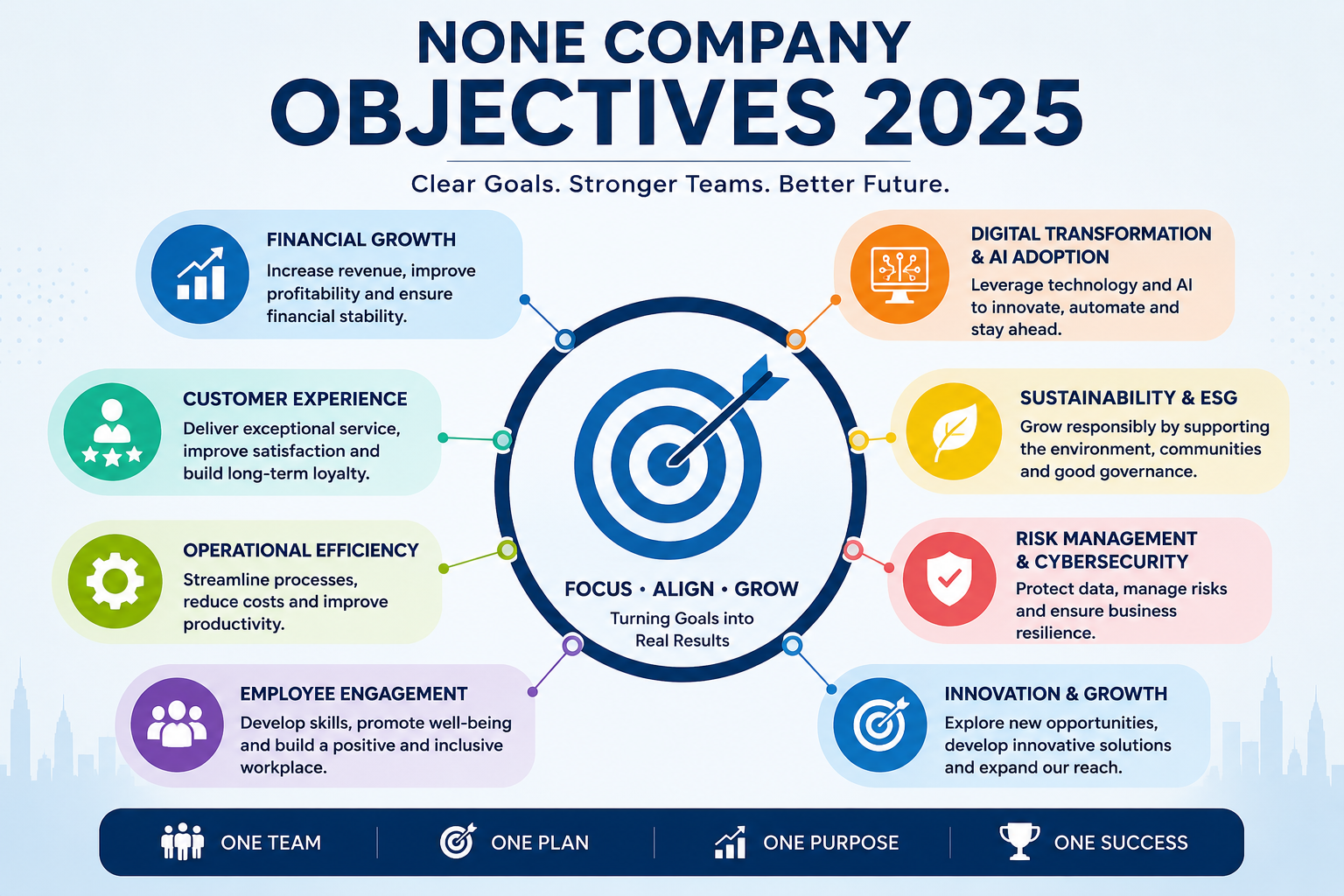
Second, it can refer to modern company goals 2025 that help businesses prepare for the current market. These goals often include digital transformation, AI in business, customer experience, operational efficiency, employee engagement, sustainable growth, and risk management.
The main idea is simple: a company should not run on guesswork. Clear objectives turn broad dreams into practical action.
A weak goal sounds like this:
“We want to grow this year.”
A stronger goal sounds like this:
“We want to increase customer retention by 15% by improving onboarding, response time, and follow-up support before the end of Q3.”
The second goal gives the team something real to work toward.
Why Clear Company Objectives Matter More in 2025
Business is moving faster than it used to. Customer expectations are higher, competition is tougher, and technology is changing how companies work every day. A company that does not define its priorities can quickly fall behind.
Clear strategic business goals help a company make better decisions. They also help employees understand what matters most. When objectives are missing, teams often waste energy on tasks that look urgent but do not support long-term growth.
Strong objectives also help with:
- Better corporate planning
- Smarter use of budget and resources
- Stronger leadership accountability
- Improved team focus
- Faster decision-making
- Better performance tracking
- More confident long-term planning
In 2025, companies also need flexible objectives. A goal that made sense in January may need adjusting by June. Market trends, customer behavior, AI tools, and economic conditions can shift quickly. That does not mean companies should keep changing direction every week. It means they should review their goals often enough to stay realistic.
Main Company Objectives Businesses Should Focus on in 2025
Financial Stability and Revenue Growth
Every business needs money coming in, but financial stability is about more than chasing sales. It means the company can manage expenses, protect cash flow, and grow without putting itself under unnecessary pressure.
A smart business growth strategy in 2025 should include clear financial targets. These may include increasing revenue, improving profit margins, reducing wasteful spending, or creating more predictable income through repeat customers or subscription models.
Examples of financial objectives include:
- Increase monthly recurring revenue by 20%
- Reduce unnecessary operating costs by 10%
- Improve profit margins by reviewing pricing and supplier costs
- Build a cash reserve for slower months
- Increase average order value through better product bundles
The goal is not just to make more money. The goal is to build a business that can survive pressure and still grow.
Customer Experience and Customer Satisfaction
Customers now expect fast service, honest communication, and smooth buying experiences. A company may have a good product, but if the support is slow or the process feels confusing, customers can easily move to another brand.
That is why customer experience and customer satisfaction should be part of every company’s 2025 objectives.
Good customer-focused goals may include:
- Reducing support response time
- Improving customer onboarding
- Making the website easier to use
- Personalizing email or sales communication
- Collecting and acting on customer feedback
- Reducing complaints and refund requests
- Improving customer retention
A simple objective could be:
“Reduce average customer support response time from 24 hours to 8 hours by the end of Q2.”
This type of goal works because it is clear, measurable, and connected to customer trust.
Digital Transformation and AI Adoption
Digital transformation is not just about buying new software. It means using technology to make the business faster, smarter, and easier to manage.
In 2025, companies are using AI in business for research, reporting, customer insights, content planning, support automation, and internal workflow improvement. But AI should not be used just because it sounds modern. It should solve a real problem.
Useful technology objectives may include:
- Automating repetitive admin tasks
- Improving reporting dashboards
- Using AI to analyze customer questions
- Moving outdated systems to cloud platforms
- Improving team collaboration through better tools
- Using data to make better sales and marketing decisions
A strong AI-related objective could be:
“Use AI-assisted support tools to handle simple customer questions while keeping trained human agents available for complex issues.”
This keeps the goal balanced. It improves efficiency without removing the human side of service.
Operational Efficiency
A company can lose money without realizing it. Slow processes, duplicated work, unclear communication, and poor project tracking can all hurt performance.
Operational efficiency means getting better results with less waste. It does not always mean cutting staff or rushing employees. Often, it means simplifying the way work gets done.
Objectives in this area may include:
- Reducing project delays
- Improving delivery speed
- Removing repeated manual tasks
- Creating clearer internal processes
- Improving inventory or supply chain tracking
- Using automation where it saves time
A practical goal could be:
“Reduce project turnaround time by 20% by improving workflow approvals and using one shared project management system.”
This type of goal helps teams work with less confusion.
Employee Engagement and Workforce Development
No company objective works without people. A business can have great plans, but if employees are confused, burned out, or unsupported, execution becomes weak.
That is why employee engagement and workforce development should be treated as serious business goals, not soft extras.
Good people-focused objectives may include:
- Improving employee training
- Creating clearer career paths
- Supporting flexible or hybrid work where possible
- Reducing employee turnover
- Improving communication between leadership and teams
- Building a healthier workplace culture
A useful objective could be:
“Train 90% of customer-facing employees on new service standards by the end of Q2.”
This gives the team a clear target and supports better customer outcomes too.
Sustainable Growth and ESG Goals
Modern companies are expected to grow responsibly. Customers, investors, and employees pay more attention to how businesses treat people, communities, and the environment.
Sustainable growth means the company is not only focused on quick wins. It is building for the long term.
In 2025, many companies are also thinking about ESG goals, which usually cover environmental, social, and governance responsibilities. These goals may include reducing waste, improving energy use, supporting inclusion, strengthening ethical standards, or being more transparent with stakeholders.
Examples include:
- Reducing packaging waste
- Improving energy efficiency
- Supporting community programs
- Using responsible suppliers
- Improving diversity and inclusion efforts
- Publishing clearer sustainability updates
A strong objective could be:
“Reduce packaging waste by 15% by switching to lighter, recyclable materials before the end of the year.”
This goal is simple, measurable, and connected to both cost control and brand trust.
Risk Management and Cybersecurity
As companies use more digital tools, they also face more digital risks. Customer data, payment systems, internal files, and business accounts all need protection.
Risk management and cybersecurity should be part of company objectives in 2025, even for small businesses.
Important goals may include:
- Training employees on phishing and password safety
- Reviewing access to company systems
- Creating a data backup plan
- Updating privacy and compliance processes
- Building a simple business continuity plan
- Reviewing supplier and platform risks
A practical cybersecurity objective could be:
“Complete quarterly security checks and train all employees on basic data protection by the end of Q3.”
This type of goal helps prevent problems before they become expensive.
How to Build Better Business Goals in 2025
Start With the Real Problem
A company should not create goals just because competitors are doing something. Before setting objectives, leaders should ask what is actually holding the business back.
The real problem might be:
- Low customer retention
- Weak online visibility
- Poor cash flow
- Slow delivery
- High employee turnover
- Outdated systems
- Too many manual tasks
- Weak sales follow-up
Once the real problem is clear, the objective becomes easier to write.
For example, if customers are leaving after the first purchase, the goal should not simply be “get more customers.” A better goal may be to improve repeat purchases, customer follow-up, and post-sale support.
Choose a Few Priorities Instead of Too Many
One common mistake is setting too many goals at once. When everything is a priority, nothing feels like a priority.
A company should choose three to five main company goals 2025 and focus on them properly. These goals should support the bigger business direction.
For example:
- Increase customer retention
- Improve operational efficiency
- Strengthen digital marketing
- Train employees on AI tools
- Improve profit margins
This is much better than having twenty vague goals that nobody tracks.
Turn Big Ideas Into SMART Goals
SMART goals make business objectives easier to understand and measure. SMART means specific, measurable, achievable, relevant, and time-bound.
A weak goal:
“Improve marketing.”
A stronger SMART goal:
“Increase organic website traffic by 30% in six months by publishing SEO content, updating old pages, and improving internal links.”
A weak goal:
“Improve employee skills.”
A stronger SMART goal:
“Complete sales training for the full sales team by the end of Q2 and improve lead conversion by 10% by Q4.”
SMART goals help teams understand what success looks like.
Use OKRs and KPIs to Track Progress
OKRs and KPIs are useful because they keep goals from becoming empty statements.
OKRs stand for objectives and key results. They help define what the company wants to achieve and what results will prove progress.
Example:
Objective: Improve customer loyalty
Key Result 1: Increase repeat purchase rate by 15%
Key Result 2: Reduce customer complaints by 20%
Key Result 3: Improve customer satisfaction score from 78% to 88%
KPIs are the numbers a company tracks regularly. They show whether progress is happening.
Useful KPIs include:
- Revenue growth
- Profit margin
- Customer retention rate
- Website conversion rate
- Customer satisfaction score
- Employee turnover rate
- Support response time
- Project completion rate
- Cost per lead
Without tracking, even a good objective can slowly disappear from daily work.
Assign Clear Owners
Every objective needs an owner. If nobody owns the goal, everyone assumes someone else is handling it.
For each objective, decide:
- Who is responsible?
- Which team is involved?
- What tools or budget are needed?
- What deadline matters?
- How often will progress be reviewed?
This creates leadership accountability and makes progress easier to manage.
A company objective should not live only in a document. It should show up in meetings, dashboards, team updates, and planning conversations.
Review Objectives Every Quarter
Annual goals are useful, but they should not be ignored for twelve months. A quarterly review helps companies stay focused while also adjusting to market changes.
During each review, ask:
- Are we still working on the right goal?
- What progress have we made?
- What is blocking us?
- Do we need more resources?
- Should the target change?
- What should we stop doing?
This keeps objectives practical instead of symbolic.
Examples of Strong Company Objectives for 2025
Here are some simple examples businesses can adjust for their own needs:
- Increase customer retention by 15% by improving onboarding and customer support.
- Reduce operating costs by 10% through better workflow automation.
- Improve monthly website leads by 25% through SEO and content marketing.
- Reduce average support response time by 50% using AI-assisted tools and trained human agents.
- Improve employee training completion to 90% by the end of Q2.
- Increase profit margin by reviewing pricing, supplier costs, and unnecessary expenses.
- Complete quarterly cybersecurity checks to reduce data protection risks.
- Expand into one new local or online market before the end of Q4.
- Reduce packaging waste by 15% through better material choices.
- Improve customer satisfaction score by 10 points through faster service and better follow-up.
These goals work because they are clear. They tell the company what to improve and how progress will be measured.
Common Mistakes Companies Should Avoid
Setting Goals That Sound Good but Mean Nothing
Words like “innovate,” “grow,” and “improve” sound positive, but they are not enough on their own.
A goal must answer: how much, by when, and why?
Instead of saying “become more innovative,” a company could say:
“Launch two new product features based on customer feedback by the end of Q3.”
That is much easier to act on.
Copying Competitors Without Understanding the Business
Competitor research is useful, but copying another company’s goals can be risky. Every business has different customers, budgets, teams, and problems.
A large company may focus on global expansion. A small business may need to focus on customer retention and cash flow first.
Good objectives should match the company’s actual stage.
Using AI Without a Clear Purpose
AI can help businesses save time, understand data, and improve service. But using AI without a clear plan can create confusion.
Before adding AI to company objectives, ask:
- What problem will AI solve?
- Who will use it?
- How will success be measured?
- What risks need to be managed?
- Where should human judgment stay involved?
The best AI objectives support people instead of replacing common sense.
Ignoring Employees When Setting Objectives
Employees often understand daily problems better than leadership realizes. They know where customers struggle, where processes slow down, and where tools are not working.
Companies should involve team members when building objectives. This does not mean every decision needs a vote, but listening to employees can make goals more realistic.
Not Measuring Progress
A goal without measurement is just a wish. If a company wants better customer service, it should track response time, satisfaction scores, complaints, and retention.
If a company wants better marketing, it should track traffic, leads, conversion rates, and cost per lead.
Measurement keeps the goal alive.
Keeping Objectives Hidden From the Team
A company cannot expect employees to support goals they do not understand. Objectives should be communicated clearly and often.
Teams should know:
- What the goal is
- Why it matters
- What their role is
- How progress is going
- What needs to improve next
Clear communication turns objectives into shared direction.
How AI and Digital Tools Can Help Companies Reach Their Objectives
AI and digital tools can support many business goals in 2025, but they work best when used with purpose.
A company can use AI for:
- Drafting reports
- Summarizing customer feedback
- Finding patterns in sales data
- Supporting basic customer questions
- Speeding up research
- Improving marketing ideas
- Automating routine tasks
Digital tools can also support performance tracking, project management, customer relationship management, finance, and team communication.
For example, a CRM system can help a sales team track leads and follow-ups. A project management tool can help operations teams reduce delays. Analytics tools can help leaders make data-driven decision making part of daily work.
Still, technology is not a full strategy by itself. A tool only helps when the company knows what it wants to improve.
How Small Businesses Can Use None Company Objectives 2025
Small businesses do not need complicated strategy documents to benefit from none company objectives 2025. They need simple, clear goals that match their size and resources.
A small business may focus on:
- Getting more repeat customers
- Improving local SEO
- Building a stronger online presence
- Reducing unnecessary costs
- Improving service speed
- Training staff
- Managing cash flow better
- Using affordable tools to save time
A small business objective could be:
“Increase repeat customers by 20% in six months by creating a follow-up email system and loyalty offer.”
Another one could be:
“Improve Google Business Profile visibility by posting weekly updates, collecting 30 new reviews, and updating service pages.”
Small businesses should not try to do everything at once. A few focused goals can create more progress than a long list of unfinished ideas.
What to Measure When Tracking Business Objectives
Financial Metrics
Track numbers that show whether the company is financially healthy.
Useful financial metrics include:
- Revenue growth
- Profit margin
- Cash flow
- Cost reduction
- Average order value
- Monthly recurring revenue
- Customer acquisition cost
Customer Metrics
Track how customers feel and behave.
Useful customer metrics include:
- Customer retention rate
- Customer satisfaction score
- Repeat purchase rate
- Net promoter score
- Support response time
- Complaint rate
- Refund rate
Operational Metrics
Track how smoothly the business runs.
Useful operational metrics include:
- Project completion rate
- Delivery time
- Process delays
- Productivity levels
- Error rate
- Automation success
- Inventory accuracy
Employee Metrics
Track whether the team is engaged, trained, and supported.
Useful employee metrics include:
- Employee engagement score
- Staff turnover
- Training completion rate
- Internal promotion rate
- Absenteeism
- Employee feedback results
Digital and Risk Metrics
Track digital growth and business protection.
Useful digital and risk metrics include:
- Website traffic
- Conversion rate
- Cost per lead
- Cybersecurity incidents
- System downtime
- Data protection performance
- Backup completion rate
The best metrics are the ones connected directly to the company’s main objectives.
How to Keep Business Objectives Practical All Year
A company should not treat objectives like a document that gets written once and forgotten. Goals need attention.
To keep objectives useful:
- Discuss them in team meetings
- Break yearly goals into quarterly targets
- Use a simple dashboard
- Share progress updates
- Celebrate small wins
- Fix blockers quickly
- Remove goals that no longer make sense
- Keep communication simple
Good objectives should help people make decisions. If a goal does not guide action, it needs to be rewritten.
What is the future of business in 2025?
The future of business in 2025 is more digital, flexible, and customer-focused. Companies are using AI in business, automation, analytics, and cloud tools to work faster and make better decisions. At the same time, customers still expect human support, trust, and personal attention.
The strongest businesses will not be the ones that chase every new trend. They will be the ones that balance technology with people, growth with responsibility, and speed with quality.
How can a company turn vague 2025 goals into clear action steps?
A company can start by choosing one real problem and turning it into a measurable target.
For example, “improve sales” is vague. A clearer action step would be:
“Increase qualified leads by 25% in six months through SEO content, email follow-ups, and better landing pages.”
After that, the company should assign an owner, choose the right KPIs, set a deadline, and review progress every month.
Which business objectives should small companies prioritize in 2025?
Small companies should focus on goals that directly protect cash flow, customers, and daily operations.
The most useful priorities are usually:
- More repeat customers
- Better online visibility
- Stronger customer service
- Lower unnecessary costs
- Faster delivery or service
- Simple digital transformation
- Better staff training
Small businesses should keep objectives realistic. A clear goal that gets finished is better than a big plan that never moves.
How often should company objectives be reviewed in 2025?
Company objectives should be reviewed at least every quarter. Fast-moving goals, such as sales, marketing, customer support, and operations, may need monthly reviews.
Quarterly reviews help leaders see what is working, what is falling behind, and what needs to change. This keeps business objectives 2025 flexible without making the company lose direction.